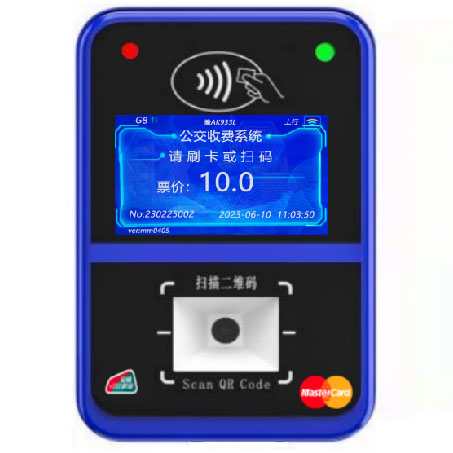
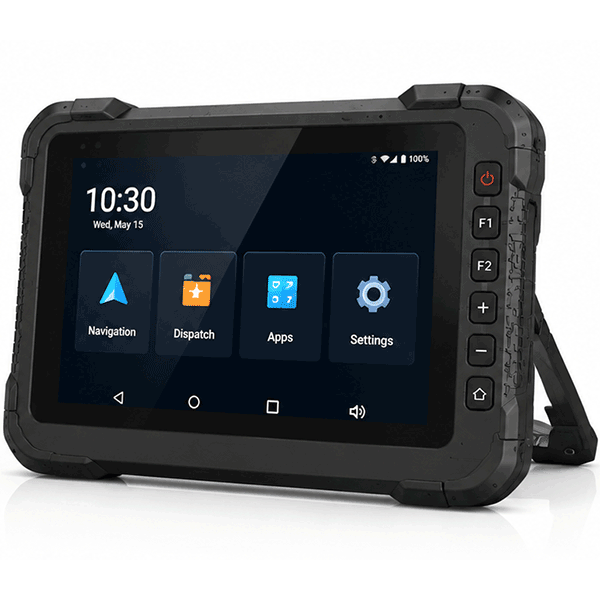
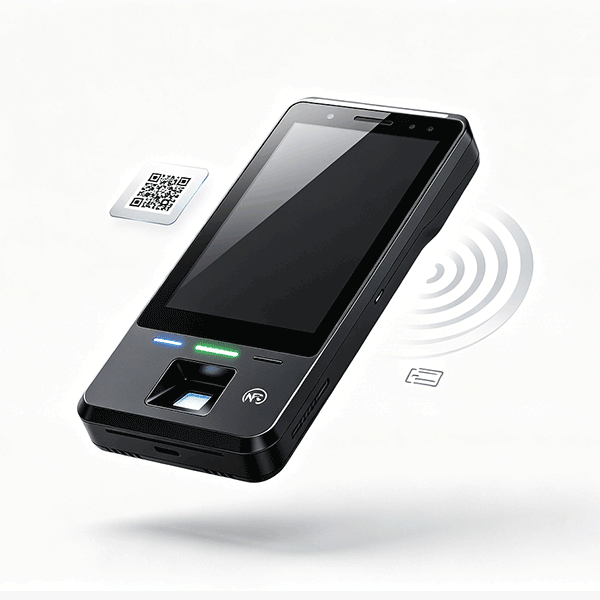
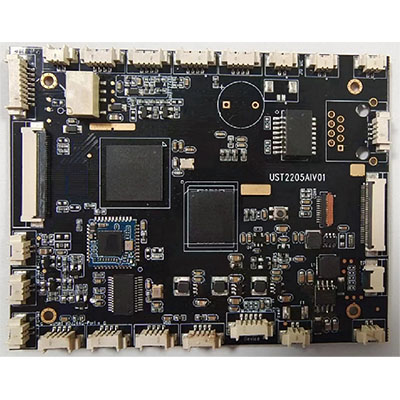
With the rapid development of smart public transportation, driven by the integration of Internet of Things (IoT), big data, and mobile payment technologies, bus fare collection machines have evolved from simple cash-only devices into intelligent, multi-functional terminals that are essential for improving operational efficiency and enhancing passenger experience. Today, as cities expand their public transit networks and passengers demand more convenient, flexible payment options, transit operators are increasingly looking for customized solutions to meet the specific needs of different cities, transit routes, and even special passenger groups. This article explores in detail the unique benefits, core features, technical specifications, and practical application value of custom bus QR code and card payment terminals, providing a comprehensive guide for transit operators seeking to upgrade their fare collection systems.
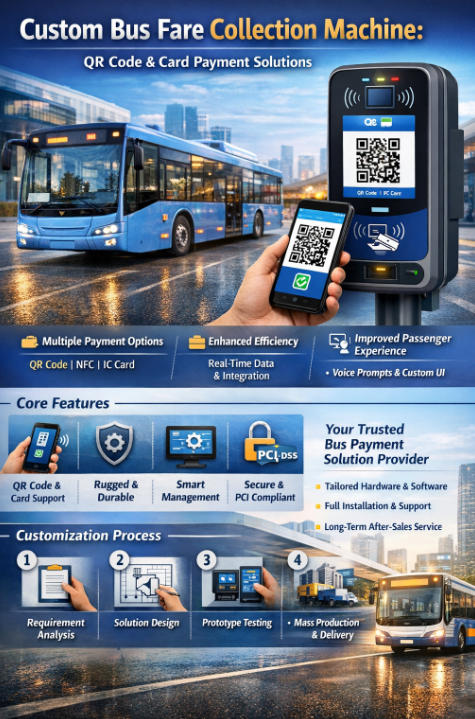
1. Advantages of Custom Bus Fare Collection Machines
Custom bus fare collection machines stand out from standard off-the-shelf models by aligning perfectly with the unique operational scenarios and user demands of each transit system. Their advantages are reflected in three key aspects: payment flexibility, operational efficiency, and passenger experience.
1.1 Support Multiple Payment Methods
In an era where digital payments have become ubiquitous, custom fare collection machines eliminate the limitations of single-payment models, catering to the diverse habits of different passenger groups—from tech-savvy young people to elderly passengers who prefer traditional payment methods.
-
Comprehensive Payment Compatibility: These terminals seamlessly support QR code payment (including mainstream platforms such as Alipay, WeChat Pay, UnionPay Cloud QuickPass, and local transit app QR codes),NFC contactless payment (for smartphones, smartwatches, and other wearable devices), and traditional IC/transit cards (including local public transit cards, intercity joint cards, and senior/citizen discount cards). This multi-payment coverage ensures that no passenger is excluded due to payment method restrictions.
-
Localized Payment Interface Customization: Unlike standard machines with fixed interfaces, custom solutions can be tailored to meet local transit regulations and operational requirements. For example, in some cities, transit systems need to integrate with local government subsidy programs—custom terminals can be programmed to automatically identify eligible passengers (such as students, seniors, or low-income groups) and apply corresponding fare discounts or subsidies. Additionally, the payment interface can be optimized to display local language, regional branding, or specific fare rules (e.g.,分段计价, transfer discounts) for greater clarity.
1.2 Improve Operational Efficiency
Transit operators face ongoing challenges in managing routes, analyzing passenger flow, and simplifying financial settlement. Custom fare collection machines address these pain points by integrating with backend management systems, enabling data-driven decision-making and streamlined operations.
-
Real-Time Data-Driven Management: The terminals are equipped with high-speed network modules (4G/5G/Wi-Fi) that enable real-time uploading of fare collection data—including transaction time, payment method, passenger volume, and route information—to the backend system. This data provides valuable insights for passenger flow analysis (e.g., peak hours, popular routes), route optimization (e.g., adjusting vehicle frequency based on passenger demand), and financial settlement (e.g., accurate reconciliation between transit operators, payment platforms, and government departments). For example, if data shows that a certain route has high passenger volume during morning rush hour, operators can add more vehicles to reduce overcrowding.
-
Seamless Backend Integration: Custom solutions are designed to integrate seamlessly with the transit operator’s existing dispatch and ticketing systems, eliminating data silos and reducing manual workload. For instance, the fare collection data can be automatically synced with the dispatch system to help operators monitor vehicle occupancy in real time, or with the financial system to automate invoice generation and settlement processes. This integration not only saves time and labor costs but also reduces the risk of manual errors.
1.3 Enhance Passenger Experience
A smooth, user-friendly fare collection process is key to improving passenger satisfaction. Custom bus fare collection machines prioritize passenger convenience through thoughtful design and personalized features.
-
Intuitive Guidance for Smooth Transactions: Equipped withclear voice prompts (available in multiple languages, including local dialects if needed) and high-brightness LED displays, the terminals guide passengers through the payment process—e.g., “Please scan your QR code,” “Card swiped successfully,” or “Insufficient balance.” This reduces confusion, especially for elderly or first-time passengers, and shortens the time spent on fare payment, minimizing delays for the entire bus.
-
Customizable Branding and UI/UX: The terminal’s user interface (UI) and external design can be customized to reflect the transit operator’s brand image. For example, the machine’s casing can be printed with the city’s transit logo or slogan, and the UI can use the operator’s brand colors and fonts. This not only enhances brand recognition but also creates a more professional and cohesive experience for passengers. Additionally, the UI can be simplified or optimized based on the target passenger group—e.g., larger fonts and icons for elderly passengers.
2. Core Features and Technical Highlights
Custom bus fare collection machines are built with advanced technology and durable hardware to adapt to the harsh operating environment of public transportation (e.g., vibration, dust, extreme temperatures) while ensuring stable performance and data security. Their core features and technical highlights are as follows:
2.1 Multi-Payment Integration: Future-Proof and Upgradeable
The core of custom fare collection machines is their ability to integrate multiple payment methods, with a modular design that supports future upgrades. The hardware is equipped with high-performance QR code scanners (with fast recognition speed of less than 0.5 seconds), NFC readers (compatible with ISO 14443/15693 standards), and IC card readers (supporting MIFARE, CPU card, and other common card types). The software system is designed to be flexible, allowing operators to add new payment methods (e.g., emerging mobile payment platforms) or update payment rules through remote upgrades, without the need to replace the entire terminal. This future-proof design ensures that the fare collection system can keep pace with technological advancements and changing passenger demands.
2.2 Durable Design: Adaptable to Harsh Environments
Bus fare collection machines operate in complex environments—exposed to dust, rain, extreme temperatures (from -20°C to 60°C), and constant vibration from the moving bus. To ensure long-term stability, custom terminals adopt a rugged design with IP65/IP67 waterproof and dustproof ratings, preventing water and dust from entering the internal components. The casing is made of high-strength aluminum alloy or engineering plastic, which is resistant to impact and corrosion. Additionally, the internal components (such as the scanner, reader, and display) are selected for their durability, ensuring that the terminal can operate continuously for 24 hours a day, 7 days a week, with a service life of 5-8 years.
2.3 Smart Management: Real-Time Monitoring and Remote Control
Custom fare collection machines are equipped with intelligent management functions that enable operators to monitor and control the terminals remotely. The backend management system provides real-time status updates for each terminal—including power status, network connection, transaction volume, and any malfunctions (e.g., scanner failure, low battery). If a terminal encounters an error, the system sends an automatic alert to the operator, who can troubleshoot remotely (e.g., restart the terminal, update the software) or dispatch maintenance personnel if necessary. This remote management capability reduces maintenance costs and minimizes downtime, ensuring that the fare collection system operates smoothly.
2.4 Secure and Compliant: Protecting Data and Transactions
Data security is a top priority for fare collection systems, as they handle sensitive information such as passenger payment details and transaction records. Custom terminals adopt advanced encryption technologies to ensure secure data transmission and storage. All transaction data is encrypted using SSL/TLS protocols during transmission to the backend system, and stored in encrypted databases to prevent unauthorized access. Additionally, the terminals comply with PCI/DSS (Payment Card Industry Data Security Standard), the global standard for securing payment card transactions, ensuring that passenger card information is protected from fraud or data breaches. Regular security updates and vulnerability scans are also provided to maintain compliance and address emerging security threats.
3. Customization Process
The customization of bus fare collection machines is a systematic process that involves close cooperation between the transit operator and the manufacturer, ensuring that the final product meets all specific requirements. The process typically consists of five key stages:
3.1 Requirement Analysis: Laying the Foundation for Customization
The first stage is a comprehensive requirement analysis, where the manufacturer’s team works closely with the transit operator to understand their specific needs. This includes assessing the number and type of bus routes (e.g., urban, suburban, intercity), vehicle types (e.g., regular buses, electric buses, articulated buses), passenger demographics (e.g., proportion of elderly, students, commuters), payment preferences (e.g., popular payment methods in the region), and existing backend systems (e.g., dispatch, ticketing, financial systems). The team also considers local transit regulations, subsidy policies, and branding requirements to ensure that the custom solution is compliant and aligned with the operator’s goals.
3.2 Solution Design: Translating Requirements into a Blueprint
Based on the requirement analysis, the manufacturer develops a detailed solution design, which includes three key components: hardware layout, payment interface, and UI/UX design. The hardware layout is optimized for the bus interior—e.g., the terminal’s size and position are designed to be easily accessible for passengers while not occupying too much space. The payment interface is customized to support the required payment methods and integrate with local subsidy programs. The UI/UX design is tailored to the target passenger group, with clear navigation, intuitive prompts, and brand-consistent visuals. The manufacturer also provides a prototype design for the operator to review and provide feedback, ensuring that the design meets their expectations.
3.3 Prototype Testing: Ensuring Performance and Reliability
Once the solution design is finalized, the manufacturer produces small batches of prototypes for rigorous testing. The testing phase focuses on performance, reliability, and user experience. Performance testing includes measuring the speed of QR code scanning and card reading, the stability of data transmission, and the terminal’s response time. Reliability testing involves simulating harsh operating environments (e.g., high/low temperatures, vibration, dust) to ensure that the terminal can operate stably under various conditions. User experience testing is conducted with actual passengers to gather feedback on the UI, voice prompts, and overall usability. Any issues identified during testing are addressed and the prototype is revised until it meets the required standards.
3.4 Mass Production & Delivery: Ensuring Quality and Timeliness
After the prototype is approved, the manufacturer proceeds to mass production. During production, strict quality control measures are implemented to ensure that each terminal meets the specifications and standards set in the solution design. The manufacturer also provides installation support—sending professional technicians to install and configure the terminals on the buses, and ensuring that they are integrated with the backend system. Delivery is scheduled according to the operator’s timeline, with clear communication to avoid delays. Additionally, the manufacturer provides training materials and on-site training for the operator’s staff, teaching them how to use and maintain the terminals.
3.5 After-Sales Service: Ensuring Long-Term Operation
A reliable after-sales service is crucial for the long-term operation of custom fare collection machines. The manufacturer provides a comprehensive after-sales service package, including remote monitoring (to detect and resolve issues in real time), software updates (to add new features and fix bugs), component replacement (for damaged or faulty parts), and ongoing training (for new staff or system upgrades). The after-sales team is available 24/7 to respond to emergency requests, ensuring that any downtime is minimized. Additionally, the manufacturer conducts regular maintenance checks to proactively identify and address potential issues, extending the service life of the terminals.
4. Partnering for Success
Choosing the right manufacturer is key to the success of a custom bus fare collection system. A professional
custom bus fare collection machine manufacturer brings expertise, experience, and a customer-centric approach to the project, providing end-to-end support from requirement analysis to after-sales service. Here’s what operators can expect from a reliable partner:
-
Personalized Branding and Interface Design: The manufacturer works closely with the operator to incorporate their brand identity into the terminal’s design, from the casing to the UI, creating a consistent and professional image.
-
Integrated Hardware and Software Development: A professional manufacturer has the capability to develop both hardware and software in-house, ensuring seamless integration between the terminal and the backend system. This eliminates compatibility issues and ensures stable performance.
-
Full Support During Installation, Testing, and Staff Training: The manufacturer provides on-site support during installation and testing, ensuring that the terminals are set up correctly and integrated with the existing systems. They also offer comprehensive training for the operator’s staff, ensuring that they can effectively use and maintain the terminals.
-
Long-Term After-Sales Service and System Upgrades: A reliable partner provides ongoing after-sales support, including remote monitoring, software updates, and component replacement. They also offer system upgrades to keep the fare collection system up-to-date with technological advancements and changing passenger demands.
In conclusion, custom bus fare collection machines are more than just payment terminals—they are a key component of a smart public transportation system. By supporting multiple payment methods, improving operational efficiency, and enhancing passenger experience, these customized solutions help transit operators meet the unique needs of their cities and passengers. Partnering with a professional manufacturer ensures that the custom solution is tailored to specific requirements, reliable, and future-proof, ultimately contributing to the development of smart city transportation and delivering a safe, convenient, and modern travel experience for all passengers.